
Watching football under the open sky—whether it’s a tailgate party in the parking lot, a backyard watch party with friends, or a cozy evening on the patio—is one of the most exhilarating ways to experience the game. But let’s be honest: not all TVs are built to handle the elements. A standard indoor television might look great in your living room, but expose it to direct sunlight, humidity, or sudden temperature swings, and you’re likely staring at a blank screen—or worse, a fried circuit board.
That’s where outdoor TVs come in. Designed specifically for use outside, these ruggedized displays are engineered to deliver crystal-clear visuals even in bright daylight, withstand rain and dust, and operate reliably in extreme temperatures. Whether you’re hosting a Super Bowl bash or catching Sunday Night Football from your deck, investing in the right outdoor TV ensures you never miss a touchdown, a game-winning field goal, or that perfectly timed replay. This comprehensive buying guide is here to help you navigate the often-confusing world of outdoor televisions, so you can make a smart, informed decision that matches your needs, budget, and viewing environment.
In this guide, you’ll learn everything you need to know about choosing the best outdoor TV for football games. We’ll break down the key features that matter most—like brightness, weather resistance, and screen technology—and explain how they impact real-world performance. You’ll discover the different types of outdoor TVs available, from fully weatherproof models to partial-sun options, and understand which one fits your setup. We’ll also highlight common pitfalls to avoid, share expert tips for getting the best deal, and answer frequently asked questions based on real user experiences. By the end, you’ll have the confidence to pick a TV that delivers an immersive, reliable, and weather-resistant viewing experience—perfect for every football season.
The outdoor TV market has evolved significantly over the past decade. What started as a niche category dominated by a few specialized brands has now expanded to include mainstream manufacturers offering high-performance, weather-resistant models. Today’s outdoor TVs aren’t just about surviving the elements—they’re about delivering a premium viewing experience that rivals indoor sets. With advancements in display technology, improved anti-glare coatings, and smarter cooling systems, modern outdoor TVs can produce vibrant colors, deep blacks, and smooth motion—even under direct sunlight. Whether you’re watching a fast-paced NFL game or a dramatic overtime finish, these TVs are built to keep up.
But with so many options on the market, it’s easy to feel overwhelmed. Prices can range from under $1,000 to well over $5,000, and not all “outdoor” TVs are created equal. Some are designed for shaded patios, while others can handle full sun exposure. Some come with built-in speakers, while others require external audio systems. And then there’s the question of installation—do you need a full outdoor enclosure, or can you mount it directly to a wall? This guide will cut through the noise and give you the clarity you need to make the right choice.
What to Look for When Buying Buying Guide
1. Brightness & Anti-Glare Performance
One of the most critical factors when choosing an outdoor TV is brightness. Unlike indoor TVs, which typically operate in dimly lit rooms, outdoor TVs must compete with natural sunlight—sometimes direct, harsh sunlight. A standard indoor TV might have a brightness of 300–500 nits, which is perfectly fine for a living room but completely inadequate for outdoor use. For football games, where fast motion and bright uniforms are common, you need a display that can deliver high luminance without washing out colors or creating glare.
Look for outdoor TVs with a minimum brightness of 700 nits, but ideally 1,000 nits or higher. Some premium models even reach 2,000 nits, which is essential for full-sun environments. High brightness ensures that the image remains visible even when the sun is shining directly on the screen. Additionally, anti-glare or anti-reflective coatings are crucial. These coatings reduce the amount of light reflected off the screen, minimizing distractions and improving contrast. Without them, you might see your own reflection or the surrounding environment instead of the game.
Another consideration is the screen’s viewing angle. Football is often a social event, with multiple people watching from different positions. A TV with a wide viewing angle (ideally 178 degrees) ensures that the picture remains clear and vibrant even when viewed from the side. OLED screens typically offer superior viewing angles compared to traditional LCDs, but they can be more expensive and less bright. For outdoor use, many manufacturers use advanced IPS (In-Plane Switching) panels that balance brightness, color accuracy, and viewing angles.
2. Weather Resistance & IP Rating
Outdoor TVs must be built to withstand the elements—rain, snow, dust, humidity, and temperature extremes. That’s why weather resistance is non-negotiable. The most reliable way to assess a TV’s durability is by checking its IP (Ingress Protection) rating. This two-digit code indicates how well the device resists solid particles (like dust) and liquids (like water).
For outdoor TVs, an IP55 or higher rating is recommended. IP55 means the TV is protected against dust (limited ingress) and low-pressure water jets from any direction. For more extreme conditions—such as coastal areas with salt spray or regions with heavy rainfall—look for IP65 or IP66 ratings. IP65 offers complete dust protection and resistance to water projected from a nozzle, while IP66 adds protection against powerful water jets.
But the IP rating is just one part of the equation. The TV’s internal components must also be sealed and protected. High-quality outdoor TVs use conformal coatings on circuit boards, sealed ports, and weatherproof gaskets around the bezel. Some models even include built-in heaters or cooling fans to regulate internal temperature. For example, in cold climates, a heater can prevent the screen from freezing, while in hot environments, a fan can prevent overheating.
3. Screen Technology: LED, QLED, or OLED?
The type of display technology used in an outdoor TV significantly impacts picture quality, brightness, and longevity. The three main options are LED, QLED, and OLED—each with its own strengths and weaknesses.
LED TVs are the most common and affordable. They use a backlight to illuminate an LCD panel, offering good brightness and color accuracy. Modern LED outdoor TVs often feature full-array local dimming (FALD), which improves contrast by dimming specific zones of the backlight. This is especially useful for football, where dark shadows and bright highlights (like stadium lights) are common.
QLED (Quantum Dot LED) TVs build on LED technology by adding a layer of quantum dots, which enhance color purity and brightness. QLED displays can achieve higher peak brightness than standard LEDs, making them ideal for sunny environments. They also offer excellent color volume, meaning colors remain vivid even at high brightness levels. Samsung is a major player in the QLED space, and their outdoor models are known for their vibrant, lifelike images.
OLED (Organic Light-Emitting Diode) TVs are considered the gold standard for picture quality. Each pixel emits its own light, allowing for perfect blacks, infinite contrast, and exceptional motion handling. This makes OLED ideal for fast-paced sports like football, where quick cuts and player movements require smooth, blur-free visuals. However, OLEDs are generally more expensive and can be less bright than QLEDs, which may be a concern in full-sun conditions. Additionally, OLED screens are more susceptible to burn-in if static images (like scoreboards) are displayed for long periods.
For most outdoor football viewing, a high-brightness QLED or advanced LED with FALD is the best balance of performance, durability, and cost. OLED is excellent if you prioritize image quality and have a shaded or covered viewing area.
4. Size & Viewing Distance
Choosing the right screen size is about more than just going big—it’s about matching the TV to your space and seating arrangement. A TV that’s too small will strain your eyes, especially in bright conditions, while one that’s too large can overwhelm the space and distort the image if viewed from too close.
As a general rule, the optimal viewing distance is 1.5 to 2.5 times the diagonal screen size. For example, a 55-inch TV should be viewed from 6.9 to 11.5 feet away. For outdoor setups, where people may be seated farther apart or move around during the game, consider a larger screen. A 65-inch or 75-inch TV is ideal for most backyard or patio setups, providing an immersive experience without requiring everyone to crowd around.
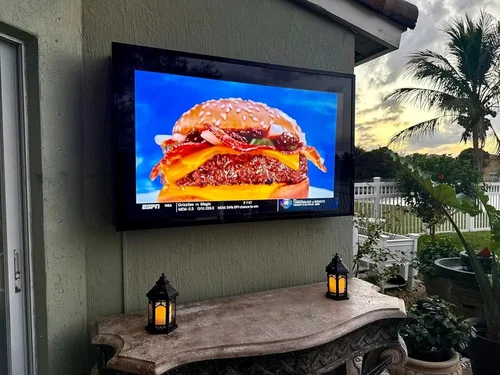
Also consider the mounting location. Will the TV be wall-mounted, on a stand, or in a weatherproof enclosure? Ensure there’s enough clearance for ventilation and that the screen is positioned at eye level when seated. Avoid placing the TV directly under a roof overhang where rain might drip, or in a spot where it’s exposed to direct afternoon sun for extended periods.
5. Audio Quality & External Sound Options
While picture quality is paramount, audio is just as important for the full football experience. The roar of the crowd, the announcer’s commentary, and the sound of cleats on turf all contribute to the atmosphere. Unfortunately, most outdoor TVs have limited built-in speakers due to space and weatherproofing constraints. The sound may be tinny, quiet, or lack bass—especially in open areas where sound dissipates quickly.
For the best audio experience, consider pairing your outdoor TV with a weather-resistant soundbar or outdoor speaker system. Many manufacturers offer compatible audio solutions designed to withstand the elements. Look for speakers with an IP rating of at least IPX5 and features like Bluetooth connectivity, wireless subwoofers, and multi-room support.
Alternatively, you can use a home theater receiver with outdoor-rated speakers mounted around the viewing area. This setup provides surround sound and greater flexibility, but it requires more planning and installation. For casual viewing, a high-quality outdoor soundbar like the Sonos Move or Bose SoundLink Revolve+ can deliver impressive sound in a compact, weather-resistant package.
6. Smart Features & Connectivity
Modern outdoor TVs come with smart platforms that allow you to stream content directly from apps like Netflix, YouTube, Hulu, and ESPN+. This is especially useful for watching live games, highlights, or pre-game shows without needing a separate streaming device.
Look for TVs with built-in Wi-Fi, Ethernet ports, and support for popular streaming services. Android TV, webOS, and Tizen are among the most user-friendly platforms, offering intuitive interfaces and regular software updates. Some models also support voice control via Google Assistant or Amazon Alexa, allowing you to change channels or search for games hands-free.
Connectivity is another key consideration. Ensure the TV has enough HDMI ports (at least three) for devices like cable boxes, gaming consoles, or streaming sticks. USB ports are useful for playing media files or updating firmware. For outdoor use, make sure all ports are sealed or covered to prevent moisture ingress.
7. Installation & Mounting Requirements
Installing an outdoor TV isn’t as simple as hanging it on the wall. You need to consider power supply, signal sources, and protection from the elements. Most outdoor TVs require a dedicated power outlet, preferably GFCI-protected to prevent electrical hazards in wet conditions.
Mounting options vary. Some TVs are designed to be mounted directly to an exterior wall, while others require a weatherproof enclosure or outdoor-rated mounting bracket. Full outdoor enclosures, like those from Seura or SunBriteTV, provide complete protection and often include built-in cooling and heating systems. These are ideal for permanent installations in exposed areas.
For temporary or semi-permanent setups, a partial-sun TV with a protective cover may suffice. Always follow the manufacturer’s installation guidelines and consider hiring a professional if you’re unsure about electrical or structural requirements.
8. Brand Reputation & Warranty
Not all outdoor TV brands are created equal. Some specialize in rugged, weather-resistant displays, while others repurpose indoor models with minor modifications. Stick with reputable brands known for quality and reliability, such as SunBriteTV, Seura, Samsung, LG, and Sony.
Warranty is another critical factor. Outdoor TVs are a significant investment, and you want assurance that they’ll last. Look for a minimum 2-year warranty, with some premium models offering up to 5 years. Check what the warranty covers—does it include labor, parts, and on-site service? Is it voided if the TV is installed incorrectly? A strong warranty reflects the manufacturer’s confidence in their product.
Different Types of Buying Guide

Common Buying Mistakes to Avoid
❌ Mistake: Buying a Standard Indoor TV for Outdoor Use
Why it’s bad: Indoor TVs are not designed to handle moisture, temperature changes, or UV exposure. Even a light rain can damage internal components, and prolonged sun exposure can fade the screen or cause overheating. The result? A costly repair or replacement.
What to do instead: Always choose a TV specifically rated for outdoor use. Look for weatherproof certifications and avoid cutting corners to save money.
❌ Mistake: Ignoring Brightness Requirements
Why it’s bad: A dim screen turns your football game into a blurry, washed-out mess. You’ll struggle to see player numbers, field markings, or the ball itself—especially during daytime games.
What to do instead: Prioritize brightness. Aim for at least 700 nits, but 1,000+ nits is ideal for sunny areas. Check reviews and specs carefully.
❌ Mistake: Overlooking Audio Needs
Why it’s bad: Poor sound ruins the experience. You might miss key commentary, crowd reactions, or the excitement of a big play.
What to do instead: Invest in a weather-resistant sound system. A good outdoor soundbar or speaker setup can transform your viewing experience.
❌ Mistake: Choosing the Wrong Size
Why it’s bad: A TV that’s too small forces viewers to squint, while one that’s too large can be overwhelming or impractical for your space.
What to do instead: Use the 1.5–2.5x rule for viewing distance. Measure your space and consider seating layout before buying.
❌ Mistake: Skimping on Installation
Why it’s bad: Improper mounting or wiring can lead to water damage, electrical issues, or even the TV falling.
What to do instead: Follow manufacturer guidelines or hire a professional installer. Ensure all connections are sealed and protected.
❌ Mistake: Not Checking the Warranty
Why it’s bad: Outdoor TVs are expensive. Without a solid warranty, a single malfunction could cost you hundreds or thousands.
What to do instead: Choose a model with at least a 2-year warranty and read the fine print. Consider extended coverage if available.
Budget Guidelines: How Much Should You Spend?
– Entry-Level ($800 – $1,500): These are typically portable TVs or indoor models in outdoor enclosures. They offer basic weather protection and decent brightness but may lack advanced features like smart platforms or high-end audio. Best for occasional use in covered areas.
– Mid-Range ($1,500 – $3,000): This is the sweet spot for most buyers. You’ll find partial-sun TVs with 700–1,000 nits brightness, smart features, and solid build quality. Ideal for patios, decks, or garages with some shade.
– Premium ($3,000 – $5,000): Fully weatherproof models designed for full sun and extreme conditions. These TVs offer 1,000+ nits brightness, advanced cooling, and premium features like QLED or OLED displays. Perfect for permanent outdoor installations.
– Luxury ($5,000+): Top-tier models from brands like SunBriteTV or Seura. These include features like built-in heaters, anti-reflective coatings, and extended warranties. Designed for luxury homes, resorts, or commercial use.
Expert Tips for Getting the Best Deal
– Buy during off-season: Prices often drop in spring and summer when demand is lower. Avoid peak football season (August–January) for better deals.
– Shop at specialty retailers: Stores like Best Buy, Crutchfield, or outdoor TV specialists often have exclusive models and expert advice.
– Check for bundle deals: Some retailers offer discounts when you buy a TV with a soundbar, mount, or installation service.
– Read user reviews: Look for feedback on brightness, durability, and customer service. Real-world experiences matter more than specs.
– Test before you buy: If possible, visit a showroom to see the TV in person. Check for glare, color accuracy, and ease of use.
– Negotiate the warranty: Some dealers may extend the warranty or include free installation if you ask.
– Consider refurbished models: Certified pre-owned outdoor TVs can save you 20–30% and often come with the same warranty.

Frequently Asked Questions
Q: Can I use a regular TV outside if I cover it?
A: Technically yes, but it’s not recommended. Even with a cover, moisture, heat, and UV exposure can damage the TV over time. A dedicated outdoor TV is a safer, longer-lasting investment.
Q: Do outdoor TVs need to be plugged in?
A: Yes. Most outdoor TVs require a standard 120V outlet. Use a GFCI outlet for safety, and ensure the power source is protected from water.
Q: How do I clean an outdoor TV screen?
A: Use a soft, lint-free cloth and a mild cleaner designed for electronics. Avoid ammonia-based cleaners or paper towels, which can scratch the screen.
Q: Can I mount an outdoor TV on a pole?
A: Yes, but only if the mount is rated for outdoor use and the pole is securely anchored. Ensure the TV is protected from wind and rain.
Q: Do outdoor TVs work in the rain?
A: Fully weatherproof models are designed to operate in light to moderate rain. However, avoid direct exposure to heavy downpours or storms.
Q: Can I use a streaming stick with an outdoor TV?
A: Yes, as long as the HDMI port is accessible and protected. Consider using a weatherproof HDMI extender or enclosure.
Q: How long do outdoor TVs last?
A: With proper care, a high-quality outdoor TV can last 7–10 years or more. Regular maintenance and avoiding extreme conditions can extend its life.
Our Final Recommendations
– Best for Budget-Conscious Buyers: SunBriteTV Veranda Series – A partial-sun model with excellent brightness and smart features at a reasonable price.
– Best Overall Value: Samsung The Terrace – A QLED outdoor TV with stunning picture quality, 1,500 nits brightness, and full weather resistance.
– Best Premium Option: Seura Outdoor TV – A luxury all-weather model with anti-glare coating, built-in cooling, and a 5-year warranty.
– Best for Beginners: LG Outdoor TV (Partial-Sun) – Easy to set up, user-friendly interface, and reliable performance for covered areas.
– Best for Advanced Users: SunBriteTV Pro Series – Built for extreme conditions with 2,000 nits brightness, OLED display, and professional-grade durability.
Conclusion: Making the Right Choice
Choosing the best outdoor TV for football games isn’t just about buying a screen—it’s about creating an unforgettable experience. Whether you’re hosting a rowdy tailgate or a quiet family watch party, the right TV will deliver crisp visuals, rich sound, and reliable performance, rain or shine. By focusing on brightness, weather resistance, screen technology, and smart features, you can find a model that fits your environment and enhances every game day.
Remember, the best TV is the one that matches your specific needs. Don’t overspend on features you won’t use, but don’t skimp on essentials like brightness and durability. Take your time, do your research, and consider your long-term goals. With the insights from this guide, you’re well-equipped to make a confident, informed decision.
So go ahead—set up that outdoor theater, invite your friends over, and get ready to cheer on your team under the stars. The perfect football experience is just a TV away.

